

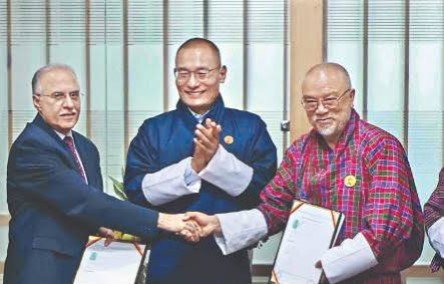
Bhutan and India are sharing the spotlight across both regional sports and strategic clean energy cooperation on Saturday, November 14, as Bhutan prepares to face India in a historic SAFF Championship 2026 semi-final clash while the Adani Group and Bhutan’s Druk Green Power Corporation (DGPC) formalize an ambitious partnership to co-develop 5,000 megawatts of hydropower capacity. On the football pitch, excitement has reached fever pitch across the Himalayan kingdom after Bhutan qualified for the semi-finals of the South Asian Football Federation Championship for the first time in 18 years, ending a nearly two-decade wait for a last-four appearance. Set against regional powerhouse India, Saturday’s high-stakes encounter also marks a major technological milestone for South Asian football, with Video Assistant Referee (VAR) technology making its official SAFF debut to enhance officiating accuracy and transparency during the knockout stage. Away from the stadium, bilateral economic ties between the two neighboring nations achieved a transformative breakthrough in the renewable energy sector through a newly signed Memorandum of Understanding between India’s Adani Group and state-owned utility DGPC to jointly develop 5,000 MW of hydropower projects across Bhutan. This landmark agreement significantly expands upon their existing collaboration on the 570/900 MW Wangchhu Hydropower Project, a joint venture structured with DGPC holding a majority 51 percent equity stake and Adani retaining 49 percent, reinforcing a balanced development model that safeguards Bhutanese ownership while leveraging Indian private-sector capital and engineering execution. Further underscoring New Delhi’s sustained commitment to Bhutan’s clean energy infrastructure, Indian Ambassador to Bhutan Sandeep Arya recently visited Trashiyangtse district to conduct an on-site review of construction progress at the 600 MW Khorlochhu hydropower plant, evaluating project timelines, technical milestones, and regional connectivity benefits. Hydropower remains the cornerstone of Bhutan’s economy and bilateral trade with India, generating vital export revenues while supplying reliable, zero-emission electricity to meet India’s rapidly growing industrial and domestic power demands. Together, these parallel developments highlight the multifaceted depth of India-Bhutan relations—uniting millions of fans through spirited sporting rivalry on a historic night for Bhutanese football, while simultaneously advancing multi-billion-dollar clean energy infrastructure that promises long-term economic prosperity, energy security, and sustainable regional integration for both nations.