

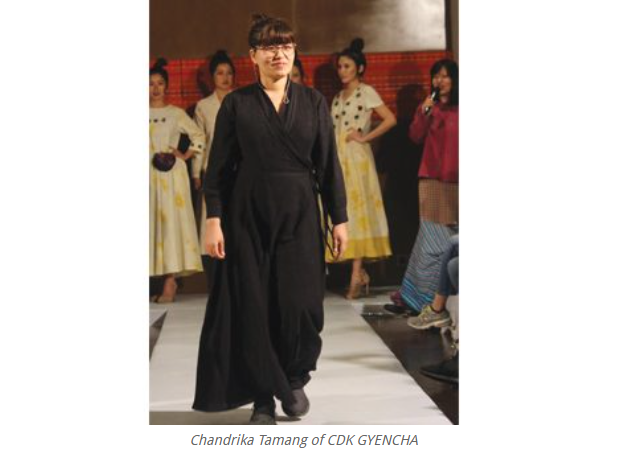
Agency: Chandrika Tamang, has decided to withdraw her design house, CDK GYENCHA, from the upcoming Bhutan Fashion Week (BFW) after the Department of Media, Creative Industry and Intellectual Property (DoMCIIP) and the Royal Textile Academy (RTA) declined her pleas to give her a co-founder status or even proper due credit for coming up with BFW and its concepts, themes and other details.
Chandrika said, “After seeing everything, I have decided not to participate. I think the main thing of this fashion week was to show the world how sustainable we are and how it is an ethical fashion show but we have lost that ethical thing here, and so it has now become an unethical fashion show. Our first fashion week was an opportunity to show really sustainable and ethical fashion to the world.”
She said she only really joined initially because BFW was her baby and she wanted to see how it goes but she was also disappointed in the way they are going about things as so much more could have been done.
Instead DoMCIIP came out with a three page press release on 7th September Sunday night trying to argue why Chandrika could not be given her due and with the RTA also coming up with a similar two-page release on Monday evening on 8th September.
Some actors, musicians and social media influencers, who have been receiving grants, jobs and foreign trips from DoMCIIP under the Nu 530 mn Creative Industry ESP fund, promptly shared the press releases on their handles. Even some newspapers who never did the story carried the DoMCIIP release.
The Bhutanese did its own research and also contacted a lawyer who specializes in Intellectual Property law over the various issues raised in the two press releases
‘Stolen Ideas’
The DoMCIIP release argued that there is no such thing as ‘stolen ideas’ and that copyright only protects the expression of ideas and not ideas or concepts. It says Expression means the way an idea is fixed in a tangible form like a written proposal, a painting, logo or a photograph.
It says for there to be copyright infringement Chandrika’s fashion week proposal would have to be produced word-for-word, or in a way that substantially replicates its original expression. It claims that for BFW the concepts and strategies of the consultants hired to implement these generic ideas into a tangible form were unique in their own way and so no infringement is detected.
It also quoted section 7 of the Copyright Act which says subject matter which are not protected are, ‘Any idea, procedure, system, method of operation, concept, discovery, or mere data, even if it is or they are expressed, described, explained, illustrated, or embodied in a work.’
DoMCIIP’s rebuttal is self-contradictory.
The exclusions above under section 7 applies to the abstract concept. When an idea is given a concrete, original form, that form becomes protectable as said by DoMCIIP itself.
Chandrika’s BFW proposal was not a vague idea that was expressed but a written proposal with proper structure, format, theme and unique content that was acknowledged by the RTA several times in email correspondence and messages.
There were online presentations made too with minutes of the meeting of the RTA attributing the BFW name and presentation to Chandrika. The above by itself qualifies for protection under Bhutanese copyright law.
The DoMCIIP says that for copyright infringement BFW would have to substantially replicate Chandrika’s fashion week proposal in its original expression which is what happened as shown in the last article by this paper.
Many things like the name Bhutan Fashion Week (BFW); Sustainable Fashion concept; a multi-day event, 5Ws (What, Where, When, Why, Whom) and 1 H (How) way of explaining BFW; the theme of past, present and future; Bhutanese talent working with international counterparts; fashion stalls where buyers can buy the products; locations of the show; national platform where designers, brands, buyers, media, and influencers come together; collaborating with some international fashion talent; doing it once a year in Bhutan ; and integrating photographers, stylists, creative and professionals into a single curated experience were all substantially replicated by RTA and DoMCIIP from its original expression in Chandrika’s written proposals, presentations and messages.
The above apart from not being abstract thoughts are the tangible embodiment of her creative intellect, meticulously structured and articulated.
They constitute a ‘literary work’ as defined under Section 5(a) of the Copyright Act, which includes “books, pamphlets, articles, computer programs and other writings”.
A detailed proposal, outlining a complex event with specific operational procedures, falls squarely within the ambit of ‘other writings’ and is an ‘original intellectual creation in the literary and artistic domain,’ as per the Copyright Act.
DoMCIIP contradicting section 8 and 9 of Copyright Act
By claiming ideas cannot be protected and infringement requires exact copying, DoMCIIP is contradicting Sections 8 and 9 of the Copyright Act.
The replication of the core structural and thematic elements constitutes an infringement under Section 8(1) of the Copyright Act which grants the author “the exclusive right to carry out or to authorize” various acts, including reproduction, adaptation, and communication to the public.
Her work has been ‘adapted’ without her permission and the public announcement and subsequent implementation of BFW, mirroring Chandrika’s detailed plan, can be construed as an unauthorized ‘communication to the public’ of the work.
DoMCIIP’s assertion that ‘no infringement is detected’ because the concepts and strategies of their hired consultants were ‘far and unique in their own way’ is a self-serving and unproven claim along with a conflict of interest given the substantial similarities pointed above, DoMCIIP’s role in executing BFW and DoMCIIP as the guardian of the Copyright Act and Industrial Property Act.
DoMCIIP and RTA are unable to prove their work is substantially different from Chandrika especially given the timeline of her submission from April 2024 onwards and the subsequent reactions and actions of RTA and DoMCIIP.
The RTA Director’s written statements via email to Chandrika on BFW saying ‘We have a lot of things to do together,’ ‘(DoMCIIP) would be better suited as the funding agency rather than interfering with our work,’ and “I would discuss it (BFW) with their team (DoMCIIP) separately tomorrow,” all said in 29th July 2024 after receiving detailed proposals and presentations from Chandrika further undermines DoMCIIP and RTA’s claim of independent creation and highlights the direct appropriation of Chandrika’s work.