

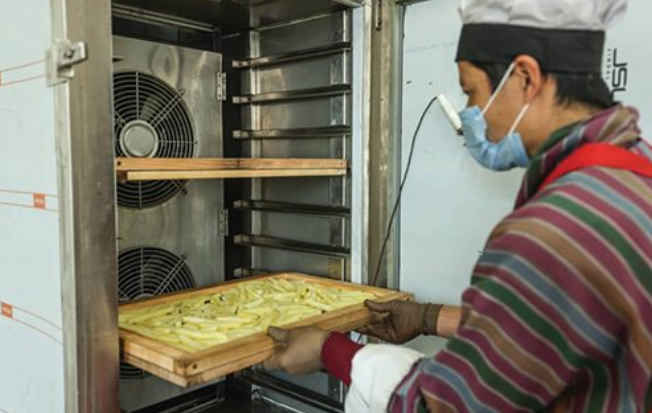
Agency: In line with that promise, MoICE tried to push for the Nu 10 million (mn) ESP loan of Jangchub that had earlier been rejected.
The matter was put up for special discussion even in the main ESP committee, but it was rejected as it was felt that if Jangchub is given the loan then there were around 1,600 people whose loans were rejected and many of them would have to be made eligible, and in that scenario, the ESP funds would not be enough.
There was also a fear that if Jangchub’s loan is pushed through then there could be allegations of favoritism, etc., in the middle of all the controversy around the ESP loans.
Jangchub has been told he can apply when the Venture Capital fund comes, but he does not have much hope now.
If the denial of funds was not enough, the Department of Agricultural Marketing and Cooperatives (DAMC)’s National Post Harvest Center recently published a report on ‘Production and Cost Analysis of Locally Processed Frozen French fries on Trial’ that essentially said the cost of production of local frozen fries is much higher than imported fries, and it also does not match up to quality.
The first claim the report made, based on its own experimental production of frozen fries, was that the cost of production of local frozen fries was Nu 375.14 per kg.
It said in comparison a wholesaler imports frozen fries at Nu 155 to Nu 156 per kg and sells it to retailers and restaurants at Nu 194 to Nu 170.
Here, Jangchub Dorji said that when he was doing 50 kg of frozen fries a day, he was selling the fries at Nu 130 per kg and he still had enough profit to pay two staff Nu 10,000 each, the rent packaging costs and all other expenses.
He said while retailers buy at Nu 190 from wholesalers, they charge around 250 to clients. Jangchub said his plan was that once he was doing 300 kg a day after buying the machines from the ESP loans, he would charge lower than wholesalers and ensure that retailers sell at Nu 230 with a price advantage.
Jangchub said he buys his potatoes at wholesale from farmers at around Nu 36 per kg.
Jangchub said that imported frozen fries claim to be 500 gm, but in reality, they are closer to 400 gm.
The report said the difference in costs could be due to the fact that since this was a trial the production scale was smaller, raw material and labour costs are higher, and the recovery rate of the raw material is comparatively less leading to additional costs incurred per kg production of frozen french fries.
It, however, said that process automation and mechanization could, however, lead to reduced costs.
Jangchub said that while the above factors are true, he could sell his frozen fries at Nu 130 and still turn a profit.
The report said that out of Yusi-Maap (Chukha) 50 kg potatoes, the frozen fries derived was only 18.39 kg, while it was 22.72 kg for Yusi-Maap (Paro) and 19.27 kg for Yusi-Chip 1.
Here, Jangchub said the international standard for wastage is only 33.33% and so he does not know how the National Post Harvest Center managed to head into 64% to 58% wastage.
Jangchub said that when he used 50 kg of fries, the frozen fries he got was 33 kg.
The report further said that local fries become darker more quickly when frying, dirties the frying oil faster affecting the oil reusability, storage is questionable as responders reported poor storage performance in previously available locally processed sample products.
Jangchub acknowledged the above issues, but at the same time, he said this is why he applied for the ESP loan to get automated machines that would reduce these issues.
He said local fries becoming darker quicker was due to the higher sugar content of local potatoes and this could have been tackled with the automated machines and process which would reduce the sugar content. At the same time, he said when he did a trial at a restaurant, the fries and oil did not turn colour as the local fries had to be put in lesser quantity which is a bit less than full.