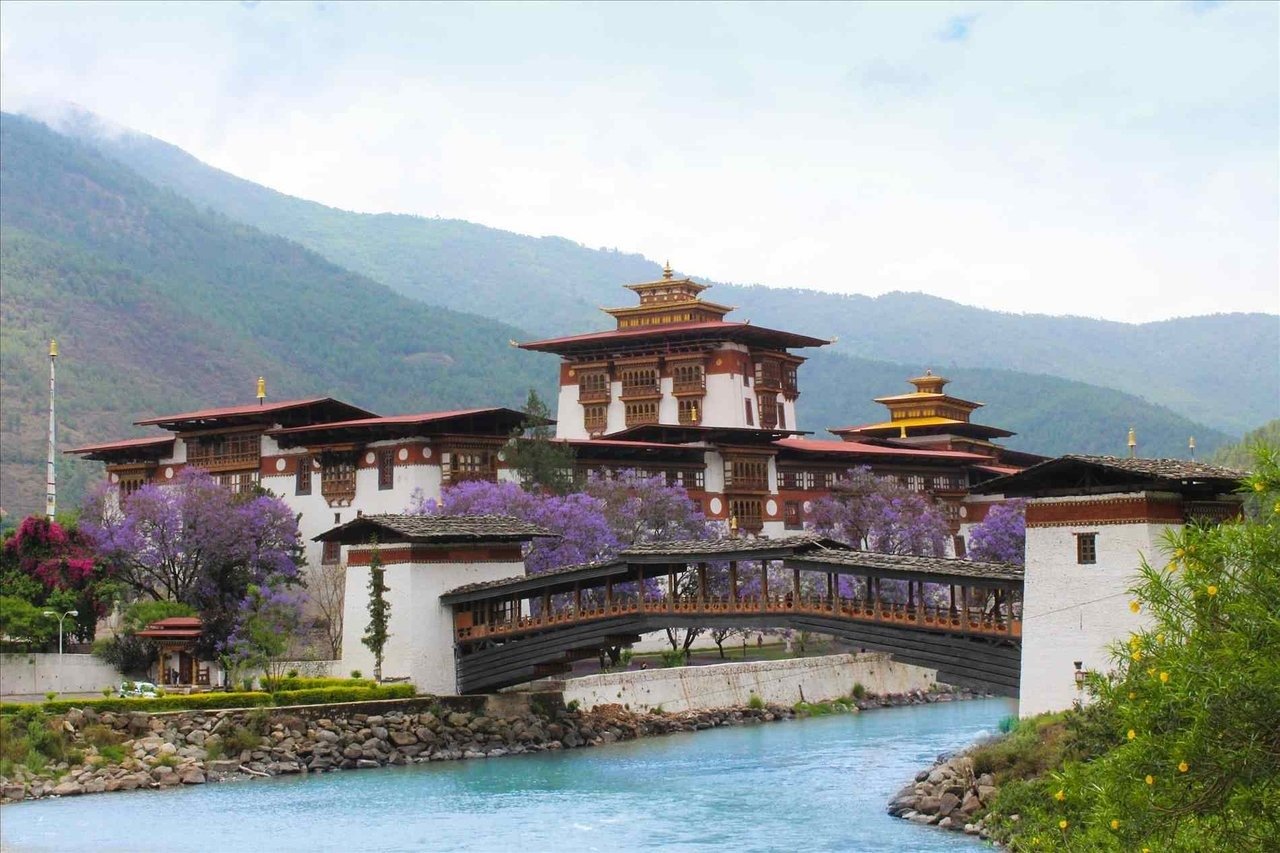
At the confluence of the Phochhu and Mochhu rivers stands the majestic Punakha Dzong, one of Bhutan’s most revered architectural landmarks. Built in 1637/38, the dzong served as the country’s capital and seat of government for more than three centuries and continues to function as the summer residence of the Central Monastic Body.
Connecting the dzong to the main road is the iconic Punakha Bazam—today celebrated as the world’s longest wooden cantilever bridge with an unsupported span. More than just a crossing, the Bazam embodies Bhutan’s architectural ingenuity and cultural continuity.
Traditional Bhutanese bridges, known as “bazams,” were born out of necessity in a mountainous landscape where ordinary timber bridges could span only about 10 meters. Cantilever techniques allowed builders to stretch farther across wide rivers. However, nature repeatedly tested these structures. The original Punakha Bazam was first destroyed by a glacial lake outburst flood in 1958. A devastating flood again struck the area in 1994, damaging the dzong and sweeping away the historic bridge.
For decades, a simple steel cable suspension bridge provided access to the dzong. But restoring the traditional Bazam proved complex. Replicating the intricate wooden cantilever design while ensuring modern safety standards required both craftsmanship and engineering innovation.
In 2000, then Prime Minister Sangay Ngedup entrusted Pro Bhutan, a German non-profit organization, with rebuilding the bridge in its traditional style. Construction began after dismantling the steel bridge in 2007. The new structure, measuring approximately 55 meters in length and rising about 180 feet above the river, was completed and opened to the public on May 12, 2008, by former Prime Minister Jigmi Y. Thinley and Pro Bhutan executive chairman Harald N. Nestroy.
The reconstruction seamlessly blended traditional Bhutanese woodworking with discreet modern reinforcements to enhance stability and prevent twisting. Though authentic in appearance, the bridge incorporates contemporary structural techniques to withstand the region’s high flood risk.
Funded through private donations from Germany at a cost of €850,000, including support from the German Embassy in India, the project stands as a testament to international collaboration and heritage preservation.
Today, the Punakha Bazam does more than link riverbanks—it connects Bhutan’s storied past with its resilient present, standing as an enduring symbol of faith, craftsmanship, and architectural brilliance in the heart of Punakha.
Punakha Bazam: World’s Longest Wooden Cantilever Bridge Rebuilt as Symbol of Bhutan’s Resilience

Bynanika
Feb 27, 2026