

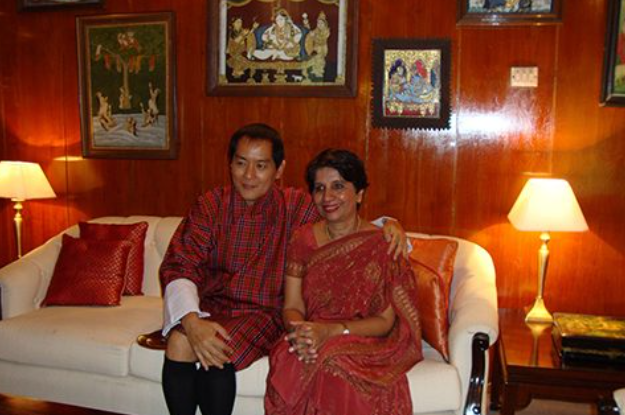
Agency: By the time His Majesty the Fourth King of Bhutan Jigme Singye Wangchuck ascended to the throne in 1972, the roots of the India-Bhutan relationship had already been planted firmly. The relationship in the early years since India’s Independence, built primarily between the Third King (1952-1972) and Prime Minister Jawaharlal Nehru (1947-1964) rested on three anchors that continue to give the relationship its weight- The first is the bond shared by the leadership in Delhi and Thimphu, across the decades. The second is India’s assistance in Bhutan’s development: harnessing Bhutan’s richest renewable resource of hydropower and the maintenance of roads in Bhutan by India’s Border Roads Organisations (BRO), as well as the provision of education, skilling and opportunities to Bhutanese youth. The third is Bhutan’s turn to India rather than its other big neighbour China, on matters of diplomacy, development and democracy, where they share many of the same values.
All three Kings of Bhutan (Third, Fourth and The Present King His Majesty Jigme Khesar Namgyel Wangchuck) have been Chief Guests at India’s Republic Day Parade, all Bhutanese Prime Ministers visit Delhi as honoured guests and all Indian leaders including Current Prime Minister Narendra Modi visit Bhutan amongst their first forays abroad after coming to office.
Planned development in Bhutan began with the First Five Year Plan (FYP) of Bhutan in 1961, and India has always provided assistance for the plans. Ties have been cemented by infrastructure development in Bhutan. The Indian Border Roads Organisation has built 1,600 kilometres of roads, 120 kilometres of tracks, 5,000 metres of bridges, helipads, Paro airport and the country’s telecommunications network along them as ‘Project Dantak’, that also began in 1961.
Meanwhile, the India-Bhutan collaboration on hydropower, called the “centrepiece” of bilateral relations by Prime Minister Dasho Tshering Tobgay has powered better ties since 1961 with the signing of the Jaldhaka project to provide electricity to southern Bhutan, and then with the 1964 336 MW Chukha Hydropower project, the first such initiative by India in Bhutan. Prime Minister Modi’s upcoming visit to Bhutan during the birthday celebrations of His Majesty The Fourth King will see the formal inauguration of the 1,020 MW Punatsangchhu-II Hydroelectric Project (PHEP-II), the latest in a long line of mutually beneficial ventures.
At all times, the relationship has worked only as it is seen in the mutual interest of both countries, not one or the other.
As a result, the ties have not been restricted to the leadership alone, and all former Managing Directors of Hydropower projects, many of whom have been given high national honours by their Majesties, have been specially invited to the celebrations, as have been all past Indian Ambassadors to Bhutan.
For more than half a century, it has been the constant presence of The Fourth King that Indian diplomats tasked with the relationship have always counted on, and consultations continue even after he abdicated the throne, as the Fifth King now leads the India-Bhutan relationship along with the Royal Government.
“His Majesty The Fourth King is the architect of the India-Bhutan relationship today,” says former Ambassador to Bhutan (1995 -1998) Dalip Mehta who was first posted to Thimphu from 1975-1978. “This is because from the very beginning he had the foresight to see that no matter what difficulties there were, and there were several, that it was necessary to overcome them. And he was a leader with the wisdom and patience to work through them,” Mr. Mehta adds, calling the ties between the two countries The Fourth King’s “legacy to the people of both countries”