

Bhutan lies within the Eastern Himalayas, one of the world’s most important biodiversity hotspots, supporting an exceptional range of habitats from subtropical forests to alpine ecosystems. Amphibians and reptiles play vital ecological roles in these systems, regulating prey populations and serving as indicators of environmental health. Despite their importance, however, they have historically received far less scientific attention than mammals, birds, and plants. Limited research access, challenging terrain, sparse infrastructure, and a shortage of herpetological expertise have all contributed to slow progress. As a result, key questions regarding species diversity, distribution, threats, and long-term population trends remain unresolved, highlighting the urgent need for deeper research.
A recent review published on February 5, 2026, in Asian Herpetological Research (DOI: 10.3724/ahr.2095-0357.2025.0003) by researchers from the University of New England and Bhutanese institutions provides a comprehensive assessment of this knowledge gap. Drawing on 63 studies published between 1972 and 2022, the authors analyzed how herpetological research in Bhutan has evolved, where efforts have been concentrated, and which areas remain underexplored. Their objective extended beyond simply cataloging studies; they aimed to evaluate how existing knowledge can better inform future conservation and management.
The review reveals notable imbalances in research focus. Approximately 45% of studies examined reptiles, 32% focused on amphibians, and only 23% addressed both groups together. Most research was field-based, with ecology and natural history dominating the literature (35 studies). Conservation-focused work accounted for 22 studies, while critical areas such as disease and genetics were each represented by only a single study. Notably, no research addressed anatomy or physiology. Geographic bias was also evident, with southern Bhutan receiving the majority of research attention, while northern regions remain largely understudied.
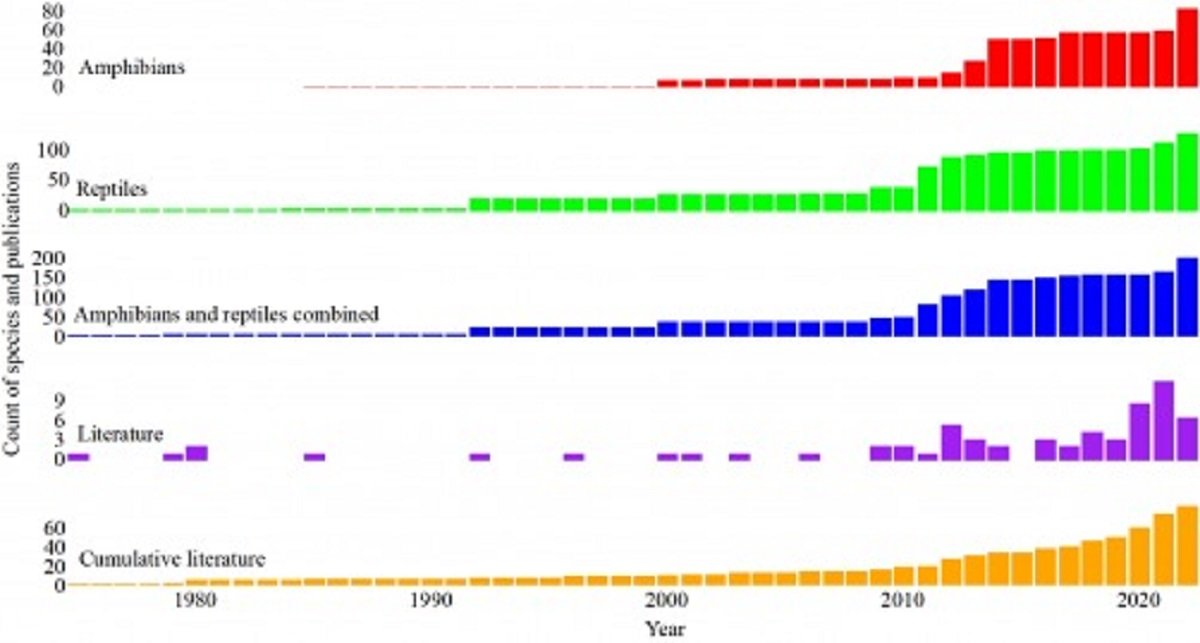
Despite these gaps, progress is evident. Research output increased significantly after 2009, accompanied by a rise in documented species records—suggesting that continued exploration directly enhances biodiversity knowledge. Bhutan is estimated to host approximately 83 amphibian species and 138 reptile species. However, the review highlights serious conservation concerns, particularly for turtles, of which 86% fall into threatened categories.
The findings underscore a critical message: Bhutan’s amphibians and reptiles are not lacking in ecological importance, but in scientific attention. While the field has advanced, future progress will depend on moving beyond species inventories toward deeper investigations into genetics, disease ecology, physiology, and long-term population monitoring. In a country widely recognized for its environmental stewardship, these often-overlooked taxa may become a key measure of how effectively science informs conservation.
The implications extend beyond Bhutan’s borders. Positioned at the intersection of major biodiversity regions and supporting high species density within a relatively small area, Bhutan has the potential to contribute significantly to conservation efforts across the Eastern Himalayas. The review calls for more interdisciplinary research, improved scientific infrastructure, expanded surveys in remote areas, and stronger collaboration among scientists, policymakers, conservation organizations, and local communities. Integrating modern scientific approaches with traditional ecological knowledge will be essential. With these efforts, Bhutan could transform from a region of underdocumented herpetological diversity into a leading model for evidence-based conservation in mountain ecosystems.