

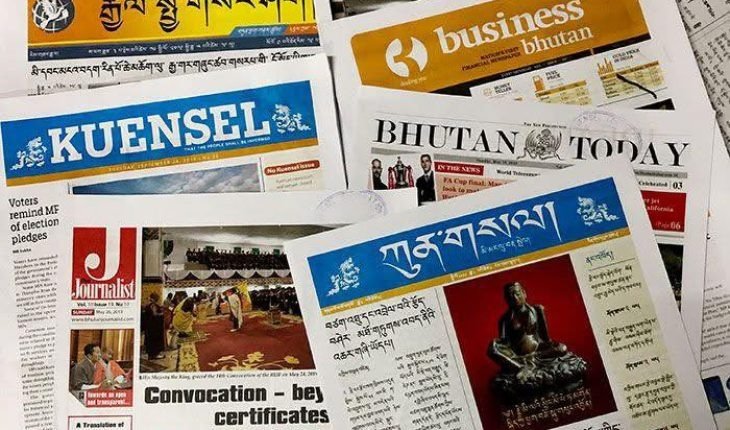
A new report released by the Journalists’ Association of Bhutan has raised questions over Bhutan’s low ranking in the 2026 World Press Freedom Index published by Reporters Without Borders, arguing that the country’s media sector is facing more economic challenges than political repression. Bhutan was ranked 150th in the latest global press freedom index, sparking debate within the country’s journalism community about whether international rankings truly reflect the realities of Bhutanese media.
The report, titled “Comprehensive Report on Perceptions of RSF’s Press Freedom Ranking and Methodology in Bhutan,” was based on responses from 49 participants, including journalists, editors, media professionals, government officials and others familiar with the country’s media landscape. According to the findings, the biggest challenge facing Bhutanese media today is financial sustainability, with nearly 92 percent of respondents identifying economic pressure as the main threat to independent journalism.
Participants said many private media houses in Bhutan are struggling to survive because of declining readership, limited advertising revenue, rising operational costs and growing competition from social media platforms. Respondents noted that Bhutan’s small market size and heavy dependence on government advertising have made it difficult for media organizations to remain financially stable.
The report also highlighted the growing loss of experienced journalists from newsrooms. Many senior reporters are reportedly leaving journalism for better-paying opportunities in international organizations, development agencies and other sectors due to low salaries and limited career growth within the media industry. Respondents warned that the departure of experienced journalists is weakening newsroom capacity and placing additional pressure on younger reporters.
Access to information was identified as another major concern. More than 81 percent of respondents said delays in receiving information from government institutions continue to affect journalism in Bhutan. However, participants largely described these problems as bureaucratic inefficiencies rather than deliberate attempts to restrict press freedom.
Despite the challenges, the report stated that Bhutan remains a relatively safe country for journalists. Around 86 percent of respondents agreed that journalists in Bhutan face fewer risks compared to those in countries where media workers encounter violence, imprisonment or political intimidation. Participants pointed to Bhutan’s democratic system, judiciary and constitutional protections for freedom of expression as important safeguards for the media.
The study also found that self-censorship exists within Bhutanese journalism, with more than 71 percent of respondents acknowledging that journalists sometimes avoid sensitive topics due to cultural values, institutional relationships or financial dependence on government support and advertising. However, many respondents said mainstream media in Bhutan continues to enjoy strong public trust because it is generally viewed as factual, balanced and less sensational compared to social media content.
The report further highlighted the influence of Bhutan’s Gross National Happiness philosophy on journalism practices in the country. Participants said the philosophy promotes ethical reporting, social harmony and responsible journalism, which they believe are often overlooked in international press freedom assessments.
A major criticism in the report was directed at the methodology used by Reporters Without Borders while preparing the World Press Freedom Index. Nearly 70 percent of respondents said the rankings do not accurately represent Bhutan’s media realities, while more than 77 percent expressed concern about the lack of transparency in selecting respondents and collecting information for the survey. Several senior journalists reportedly said they had never been consulted during the assessment process despite years of experience in the profession.
The report called on international organizations to adopt more transparent and context-sensitive methods while evaluating countries like Bhutan, where media challenges are linked more to economic fragility than direct political suppression. It also recommended broader consultation with journalists, editors and academics, along with stronger field-level research and clearer methodology explanations.
The study further stressed the need for media organizations in Bhutan to diversify revenue sources, strengthen collaboration, invest in journalist training and promote investigative reporting. Government agencies were also urged to improve transparency, reduce bureaucratic delays and cooperate more effectively with journalists to ensure easier access to information.
Bhutan’s position in the World Press Freedom Index has seen major fluctuations in recent years. The country reached its highest ranking of 33rd place in 2022 before dropping sharply to 150th in the 2026 rankings, leading to renewed debate over how press freedom is measured internationally.