

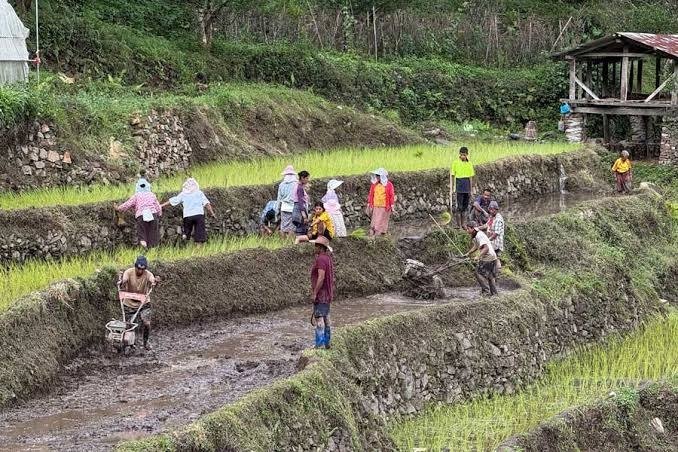
Bhutan is facing a mounting agricultural crisis as its cultivable paddy land, locally known as chhuzhing, rapidly shrinks due to unauthorized constructions, illegal conversions, and agricultural neglect, pushing the nation’s rice self-sufficiency down to about 25 percent and forcing the government to spend billions of ngultrum on massive annual food imports. Official records from the National Land Commission Secretariat reveal at least 868 documented cases of illegal structures erected on protected paddy lands without proper approval, with Punakha, Wangdue, and Paro alone accounting for 57 percent of these violations. Concurrently, the number of active paddy growers has dropped sharply from 28,516 in 2020 to 21,145 in 2024, while cultivated area plummeted by nearly half from 45,138 acres in 2013 to 23,863 acres in 2022. Despite a moratorium implemented in late 2021 by the Royal Commission on Urban Development to halt wetland transactions and conversions in the sensitive Thimphu-Paro valley and surrounding National Capital Region, persistent enforcement gaps, scattered data systems, and the absence of a comprehensive land compensation policy have complicated protection efforts. In response to these escalating food security vulnerabilities, the Ministry of Agriculture and Livestock has set an ambitious target under the 13th Plan to elevate rice self-sufficiency to 30 percent and expand paddy production to 54,040 metric tonnes by 2029, supported by increased state investments in agricultural mechanization, farmer subsidies, and land development. Furthermore, the National Land Commission Secretariat is actively implementing the FAO-funded “Safeguarding Agricultural Land for Food Security through Evidence-based Planning” (SAFE) project through June 2028, which aims to establish a rigorous chhuzhing zoning framework, introduce standardized GIS datasets across eight key districts including Trashigang and Samtse, and formulate a robust land replacement policy. By categorizing critical agricultural zones into protected and regulated tiers—where protected wetlands face permanent bans on conversion—the government hopes to resolve chronic land-use conflicts, curb illegal urban encroachment, and secure long-term agricultural resilience for the Himalayan kingdom.