

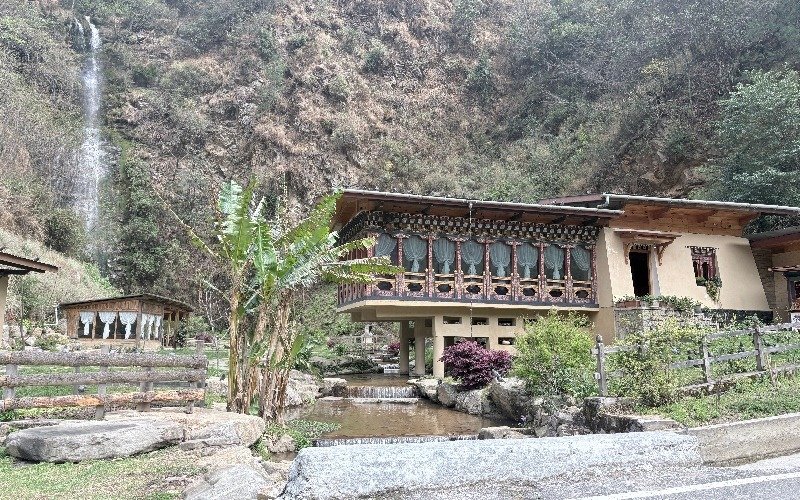
In the shadow of the majestic Trongsa Dzong, beside a roaring waterfall that once flowed past an abandoned quarry, a new story of Bhutanese entrepreneurship and homecoming is unfolding. At the heart of it is Pema Namgyel, a former United Nations professional who chose to leave behind an international career abroad and return to his roots in Willing village, Trongsa, in Central Bhutan. After nearly a decade working with the United Nations, Pema could easily have continued a comfortable life overseas. Instead, he came home carrying a vision one grounded in the belief that meaningful development begins where one’s roots are deepest. That philosophy became the foundation of the “Willing Brand,” named after his home village and built around four guiding principles: a willingness to return home, build locally, give back to the community, and dream beyond boundaries.
Today, that vision has materialized into two of Trongsa’s most distinctive hospitality destinations: the Willing Waterfall Café and Willing Resort. Few parts of the Willing story capture its spirit more vividly than the transformation of the Willing Waterfall Café. Located a few kilometers from Trongsa town just after crossing Bee Bridge, the café now sits beside a cascading waterfall along one of Bhutan’s most scenic highway corridors. But the land it occupies was once a working stone quarry in the 1990s an industrial site few imagined could become a place of beauty and hospitality. It was during the COVID-19 pandemic, when businesses around the world were shutting down and uncertainty gripped the tourism industry, that Pema decided to build.
Today, the café has become one of Trongsa’s most recognizable landmarks and a popular stop for travelers journeying between eastern and western Bhutan. Serving Bhutanese comfort food, Indian cuisine, café-style snacks, fusion dishes, and locally brewed coffee beside the waterfall, it has emerged as both a tourism hotspot and a symbol of local transformation. Its success has also contributed to the broader tourism economy of central Bhutan, attracting visitors to a region often treated merely as a transit point. Together with his wife, Lhamo, Pema expanded the vision further through Willing Resort, a Bhutanese-owned luxury boutique retreat overlooking the Mangde Chhu valley. Designed in traditional Bhutanese architectural style and guided by Feng Shui principles personally integrated by the couple, the resort offers panoramic views of the valley, surrounding mountains, and Trongsa Dzong one of Bhutan’s most historically significant fortresses.
Trongsa holds a special place in Bhutanese history as the traditional seat of the Wangchuck dynasty and the place where the Crown Prince assumes the title of Trongsa Penlop before ascending the throne.
The resort itself features 16 uniquely designed suites, including Junior Suites with valley views, Deluxe Suites with private balconies and outdoor soaking tubs, and Luxury Suites equipped with traditional wood-burning fireplaces overlooking the Dzong and Mangde Chhu River. Dining at the resort celebrates the flavors of central Bhutan using seasonal local produce. Among its most popular offerings is a blueberry cake made from wild blueberries harvested from the hills above the resort during February and March.
Its spa and wellness sanctuary combines Bhutanese healing traditions with modern therapies, offering sauna and steam experiences surrounded by wilderness, alongside an outdoor infinity pool framed by rhododendron blossoms in spring. Beyond luxury accommodation, Willing Resort aims to reposition Trongsa as a destination in its own right. Guests are encouraged to immerse themselves in the region’s living heritage through visits to Trongsa Dzong and Ta Dzong, now home to Bhutan’s Royal Heritage Museum. The resort also offers guided hikes through forests and villages, including trails to Semjee Village and the high-altitude Singye Thang route at nearly 4,000 meters, with views of Gangkar Puensum, Bhutan’s highest peak. Cultural experiences range from traditional textile dyeing workshops and pottery-making to cooking classes with local villagers. Guests can even receive personal Feng Shui consultations from Pema himself.
Visitors staying during festival season can witness some of Bhutan’s most sacred celebrations, including the Trongsa Tshechu, Yeshey Goenpi Drubchen, Pelden Lhamoi Drupchen, and the annual Black Mountain Festival.For Pema Namgyel, business success was never the ultimate objective. The Willing Brand prioritises local employment, sources produce directly from nearby farming communities and promotes responsible waste management practices. In Nubee Gewog, the brand introduced a weather forecast sharing system through WeChat to help farmers better plan planting and harvesting seasons. It also hosted Bhutan’s first-ever Farmers Festival a landmark initiative celebrating Bhutanese agriculture and recognizing the contribution of rural farming communities. Though still in its early stages, the Willing Brand has ambitious plans for expansion across Bhutan.
Future projects include a Willing Safari Lodge along the Sunkosh River in Dagana, a wellness and luxury lodge in the emerging Gelephu Mindfulness City, and another wellness lodge in Bumthang. Each project, Pema says, will continue to reflect the same philosophy that inspired his return home: locally rooted, globally inspired, and committed to giving more back to the community than it takes away.
For Pema Namgyel, returning home was never a retreat from ambition. Standing beside the waterfall in Trongsa, where a quarry once stood, it is clear that coming home became the most forward-looking decision of his life.