

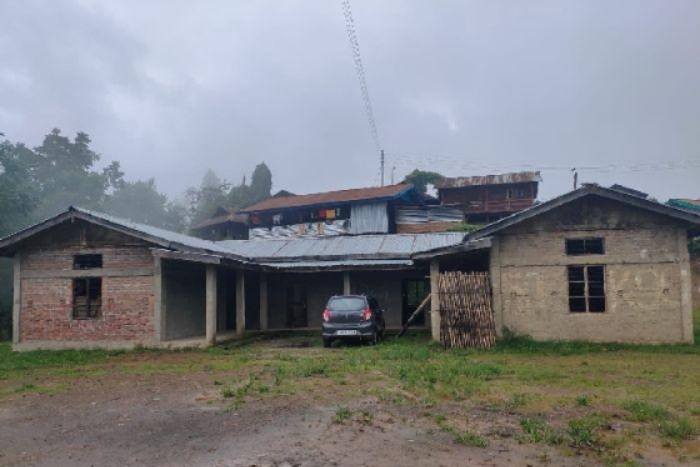
An abandoned school campus in rural Dagana is being transformed into a community-led farming project, offering new hope for livelihoods and rural revival in one of Bhutan’s depopulated villages.
Mist still hangs over the deserted grounds of the former Dogak Community School in Gozhi Gewog, where cracked pathways and rusted roofs stand as reminders of a once-thriving institution. Established in 1977, the school closed in 2017 after enrolment dropped to fewer than seven students, reflecting the wider migration of families from rural Bhutan.
Now, the five-acre abandoned campus is slowly returning to life.
Women carrying farming tools cross the overgrown grounds each morning as irrigation lines, reserve water tanks, and newly cleared plots prepare the land for cultivation. Aloe vera, cardamom, coffee, quinoa, soybean, fruits, and vegetables are expected to soon replace the silence that settled over the campus after its closure.
The initiative is being implemented under the Local Area Potential-Based Economic Development (LAPBED) programme and the Performance-Based Climate Resilient Grant component, supported by the European Union with funding assistance of Nu 1.5 million until 2027.
At the centre of the project are seven women from the Community Engagement Platform (CEP), many from financially vulnerable households, who now see farming as a pathway toward stable income and economic independence.
According to Sangay Wangmo, the project focal person, earlier CEP activities generated little or no income. “Now, this programme provides investment along with returns,” she said.
Tshering D. Ghishing said the project site belongs to Bhutan’s Ministry of Education and Skills Development. Following approval of the proposal, the gewog administration initiated procedures for land-use clearance and leasing approval while allowing provisional access so implementation could begin immediately.
The gewog administration is working closely with agriculture and livestock officials to provide technical guidance on aloe vera cultivation and integrated mixed-cropping practices. Regular monitoring, training, and on-site technical support are also planned.
For residents of Dogak and Balleygang chiwogs, the project arrives at a crucial time as rural communities continue to struggle with limited economic opportunities and dependence on subsistence farming.
Chimi Wangmo, project focal person from the Department of Local Government and Disaster Management, said the initiative aims to strengthen rural livelihoods while increasing women’s participation in income-generating activities.
“The project seeks to diversify household incomes and promote environmentally sustainable agricultural practices,” she said.
Women make up the majority of CEP members involved in the initiative, making the project not only an agricultural effort but also one focused on empowerment, collective ownership, and inclusive decision-making.
The project’s location near Dagapela town is also expected to support future market access for fresh produce and value-added products. Members hope to eventually supply produce to the upcoming Gelephu Mindfulness City, where demand for organic and wellness-based products is expected to grow.
Despite growing optimism, challenges remain.
The seven-member group has already cleared bushes across the entire site and constructed two reserve water tanks with a combined capacity of 12,000 litres using water from a nearby stream.
However, members say they still lack technical expertise in horticulture and farm management.
“For now, there is no trained member with knowledge in such farming practices,” said group representative Pema Dechen. She said training in grafting, pruning, seedling management, and horticulture would be essential for the project’s long-term sustainability.
The next phase will include fencing work to protect crops from wildlife, while the Dagana Dzongkhag Administration has committed to providing technical support.
Members have also raised concerns over delays in accessing approved funding, which they say is slowing procurement and implementation.
“This has made purchasing works difficult,” Pema Dechen said, warning that prolonged delays could discourage members who lack the resources to invest independently.
According to Lekey Wangdi, Technical Assistance Expert from the EU, the initiative is one of 13 similar LAPBED-supported projects being implemented nationwide.
“This being a community-led project requires extensive soft works and technical assistance,” he said. “The project is not just based on need, but on what can be brought to the market.”
The programme also focuses on governance, value-chain development, market linkages, business management, and gender inclusion, while encouraging other gewogs to adopt similar community-driven economic planning initiatives.