

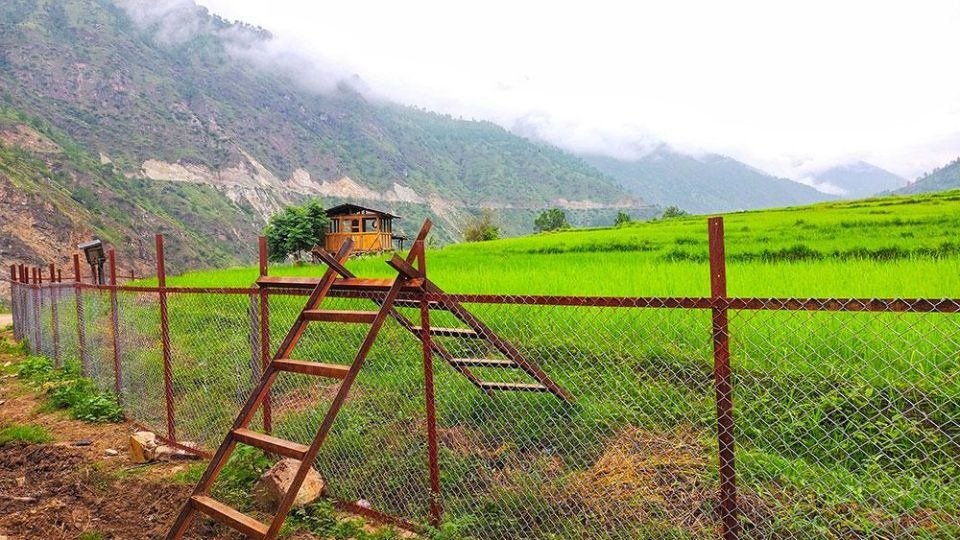
The Ministry of Agriculture and Livestock has revealed that the government spends approximately Nu 1.5 million to install one kilometre of chain-link fencing as part of Bhutan’s efforts to reduce rising human-wildlife conflict (HWC), one of the country’s most pressing agricultural challenges.
Speaking during the Question Hour session of the National Assembly of Bhutan, Younten Phuntsho said that as of the 2025–26 financial year, Bhutan has constructed 1,107 kilometres of fencing nationwide, covering 31,121 acres of farmland and benefiting 12,907 households.
The issue was raised by Sangay Thinley, who questioned the current Chain-Link Fencing Implementation Guidelines 2024, particularly the requirement that only farming communities with landholdings of 30 acres or more qualify for government support.
Referring to experiences in Yurung Gewog under Pemagatshel, the MP said households protected by fencing had seen a sharp decline in wildlife attacks, while neighbouring farmers without fencing continued to face severe crop damage and livestock predation.
He urged the ministry to lower the eligibility threshold from 30 acres to 20 acres so that smaller and fragmented farming communities could also benefit from protection measures.
Responding to the concerns, Lyonpo Younten Phuntsho said the 30-acre requirement was introduced because of limited national resources and the need to maximise economic returns from public investment. He explained that Bhutan’s agricultural policies are increasingly shifting from subsistence farming towards more commercially viable agricultural practices.
While acknowledging the concerns raised by MPs and local communities, the minister said immediate changes to the policy were unlikely, although future revisions could be considered based on recommendations from local governments and dzongkhags.
According to the ministry, 289 locations across different gewogs have already been identified and prioritised for fencing projects under the current criteria.
For farmers owning less than 30 acres, the minister pointed to the National Crop and Livestock Insurance Scheme (NCLIS), introduced last year, as an alternative form of support. More than 100 farmers have reportedly registered under the scheme so far.
The ministry also informed Parliament that Bhutan is working with the Japan International Cooperation Agency (JICA) to pilot improved fencing systems combining cement barriers, chain-link fencing, and electric fencing to protect farms from multiple wildlife species.
Officials said the pilot projects have already shown encouraging results, with fenced areas reporting higher agricultural productivity and fewer wildlife-related losses.
Human-wildlife conflict continues to significantly affect Bhutan’s farming communities. Government data showed that between 2013 and 2017, the country lost nearly 8,000 metric tonnes of agricultural production due to wildlife depredation. Nearly 40 percent of Bhutan’s approximately 66,000 farming households currently identify HWC as a major obstacle to agricultural productivity.
Several MPs also raised concerns over labour shortages linked to Bhutan’s ageing rural population and continued rural-to-urban migration. Lamdra Wangdi highlighted that many villages are now largely inhabited by elderly residents who struggle to contribute labour for fencing installation projects.
The minister acknowledged these challenges and said the government is exploring alternative arrangements to address labour shortages and ensure fencing projects can continue effectively despite demographic changes in rural Bhutan.