

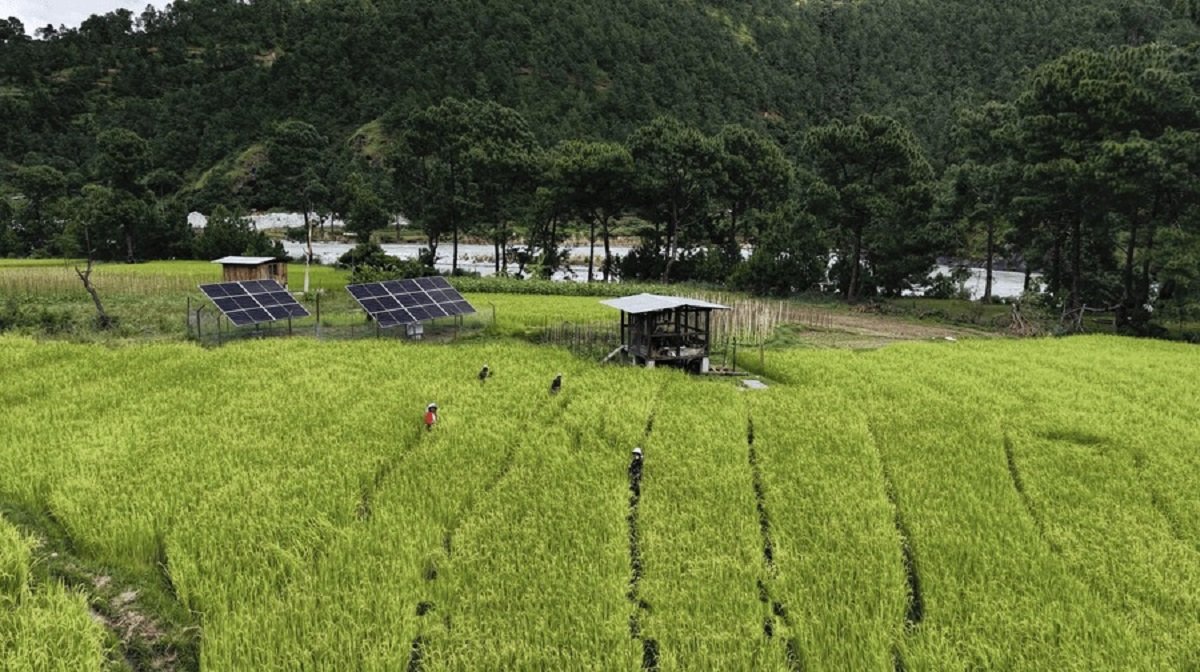
Women make up more than half of Bhutan’s agricultural workforce, according to the Industry Census Report. Yet, they have often had little say in the technologies designed to make farming easier. In Punakha, that is changing. A renewable energy project is putting women at the centre of that change.
For 23-year-old Pema Zangmo of Tempakha Village in Punakha, farming has been a way of life since she left school shortly after class seven to support her family. Growing up in a household of ten, she says farming was never easy.For years, she and her father spent hours carrying water from streams to irrigate their fields. They would spend more than four hours a day irrigating by hand, repeating the laborious process 20 to 25 times during the growing season.
“Before the solar system was installed, farming was very difficult, especially during the winter season because the water was limited, and we had to get the water from distant sources, and we had to wait more than twelve days for our irrigation turns. And we had to dig trenches every year to bring water from the mountain to the field.”
Things are different now. Under the Women’s Empowerment through Renewable Energy Powered Decentralised Lift Irrigation Systems (WERELIS) Project, a solar-powered lift irrigation system was installed in May this year.Pema was nominated by her community to operate the system for the newly formed Tempakha Water Users’ Association in Chhubu Gewog.
Through hands-on training, she has learnt to operate and maintain the system, from cleaning the solar panels to identifying minor faults. She also manages the water distribution schedule for the eight households using the system, making sure each farmer gets their allocated share.
And because the system can be switched on and off remotely, Pema saves several hours a week.
“After the installation of the solar system, our farming has become easier. We don’t have to worry about water. Farmers get water when I press a single button in my mobile app. We no longer have to carry the water physically, so we can get water efficiently, and we can even plan our farming activities with greater confidence”
Pema is one of the nine households benefiting from the project. But the project is about more than bringing water to the fields. It is also changing who gets to operate the technology, manage it and have a say in how it is used.
Women are at the centre of the water users’ association, taking on responsibilities that traditionally have not been theirs.
“Data shows that more women are doing the farming, but they don’t have access to technology; they don’t even know, and they are not part of some of these groups who are making the decisions on the technology. They need the technology most, but they are not included in the decision-making around that technology. So that is what I think the WERELIS project has really been able to show us: that yes, women can be a user of technology, they can monitor technology, they can use it, they can be part of the design, given the opportunity,” said Sarala Khaling, Head of Resilient Economies and Landscapes, ICIMOD.
Supported by the International Development Research Centre and the International Centre for Integrated Mountain Development in Canada, the project is also generating lessons that could be applied across the Hindu Kush Himalaya.
The project was among the initiatives discussed at a regional forum in Thimphu this week. Bhutan is already looking at expanding the approach.
The Department of Energy is working to scale up this project with funding from the Government of India under the Project-AID assistance.
“For areas like Punakha and Wangdue, we have conducted detailed feasibility studies across seven sites, and then the Department of Energy is undertaking the implementation of two sites. And then again, we have started conducting detailed feasibility studies with support from ICIMOD across 10 sites in Bhutan. We plan to implement this in one of the sites in the current fiscal year,” said Rigzin Pelzang, Engineer, Department of Energy, MoENR.
For Pema, the change is more than simply having water at the press of a button. It means less time spent carrying water, greater certainty over irrigation and more control over how she manages her farm.